Showing posts with label David Bowie. Show all posts

Saturday, July 11, 2020

The Temple - Shoden-ji

In 1600, Mototada promised Tokugawa Ieyasu that he could hold rival Mitsunari’s advancing army at bay. But when Mototada saw that the battle was definitely lost, he refused to be captured. Instead, he and his remaining 375 samurai warriors committed ritual suicide. Their blood soaked the floorboards of Fushima Castle. Eventually, when Tokugawa Ieyasu vanquished Mitsunari, he salvaged the blood soaked floorboards of the castle, and used them as ceiling boards in four temples across Kyoto. There the spirits of the fallen warrior could be prayed for in peace, and the bloody footprints would remind visitors of their loyalty to Tokugawa Ieyasu.

Shoden-ji is one of the four temples with the bloody ceiling boards. Tucked into the mountain, Shoden-ji is surrounded by nature. Sitting on the engawa (wooden-floored veranda) of the main temple, one can see distant views of Mt. Hiei from the terrace overlooking its rock garden. 


section through temple

plan

bloody ceiling

In the winter of December 1979, Bowie stood still and shed tears while gazing at the garden. The temple is known for its beautiful karesansui dry landscape garden. Bowie was there to make a TV commercial for Takara Shuzo, a distiller of shochu spirits. The company hired Bowie to give the liquor a makeover. It had been seen as cheap hooch for middle-aged men. Takara wanted to make shochu fashionable to women and younger drinkers.

Takara hired Bowie, an aficionado of Japanese culture known for his fine sense of aesthetics to promote its spirits. "We thought of different temples for the filming of the commercial, but Bowie, who knew Kyoto very well, chose Shodenji Temple," said Yoshiro Hosomi, who was then head of the company's advertising department.

Hosomi, who would later become chairman of Takara and deputy mayor of Kyoto, never heard of the temple's existence, despite having lived in Kyoto for 25 years. When he first visited the temple for the filming of the commercial, Hosomi understood why Bowie chose it as the setting - raked gravel, scattered rocks and bushes enhanced by the view of Mount Hiei. With few tourists, the temple was a place of tranquility.

"During the filming, while Bowie stared at the garden with tears in his eyes," Hosomi recalled. "I couldn't bring myself to ask whether he was moved by the scenery or was feeling sorrow for some reason," he said. "He was a sensitive and pure person."

In addition to starring in the commercial, Bowie wrote the synthesizer music titled "Crystal Japan". Sales of Takara’s shochu soared elevenfold between 1980 and 1985. Bowie's commercial

Friday, July 10, 2020

The Author - Mishima

On his way to New Mexico from L.A. for The Man Who Fell to Earth film shoot, Bowie brought hundreds upon hundreds of books with him-- a “traveling library”. When not performing or acting, Bowie is said to have read 4 books a week. While living in nyc, he was a regular sighting at his local bookstore, McNally Jackson in Soho. In 2016, to commemorate his death, the New York Public Library listed Bowie's 100 favorite books. Click here for the list

Japanese author Yukio Mishima was one of Bowie’s favorites, with Mishima’s The Sailor Who Fell From Grace With the Sea referenced in everything from “Heroes” to Bowie’s regular 1990's internet pseudonym “sailor.” 


“Heat,” the final track of The Next Day, opens with a reference to Spring Snow, the first part of Mishima’s last work, the Sea of Fertility quartet, which focuses on reincarnation, glamour, decadence, death and transformation. Text by Mishima is also hidden in "Valentine's Day", in which Bowie presents us with the figure of a frustrated boy planning a school shooting. Mishima writes in "The Torment and the Ecstasy": "... I imagined, on the one hand, satisfied, with how much severity I would punish the teachers and the comrades who tormented me every day one by one, but on the other hand I saw myself also supreme artist, serene and perfect, sovereign of my inner world: poor in appearance, but spiritually richer than anyone else. For a boy so hopelessly reserved and closed, Was it not natural to consider oneself a chosen creature? It seemed to me that I was expected somewhere in the world, called to fulfill a mission that was still unknown to myself."

While living in Berlin in 1977, 30 year old David Bowie hung his expressionist portrait of Japanese writer Yukio Mishima behind his bed. Bowie loved problematic art- art that poses questions rather than rendered subjects pretty. In mishima, he found dialectics and paradoxes and extremes of Japanese culture. To the actress Hideko Muramatsu, Mishima said human beings are made of opposite halves: love and cruelty, tenderness and hatred. “Try to express both sides at the same time. Then the personality you create will be more profoundly expressed.” 


Mishima was a gay man who married a woman and had two children; he lived in a European style villa while obsessed with restoring traditional Japanese culture, the power of the emperor and the Japanese army. He worked with a schedule like a banker, but dressed in shades, loud sport shirts, and gold chains. At parties, he’d roll on his back to do impressions of a dog or imitate Marlon Brando, then dismiss everyone before midnight so he could continue writing. Skinny and frail as a child, he worked out his muscles and became a sword master later in life. By the mid-Sixties, he’d set upon two goals: write a masterpiece and die by ritual suicide to protest Japan's loss of culture, decadence, and westernization.

(From Wikipedia) "On November 25, 1970, Mishima and four members of the Tatenokai (his organized army), under pretext, visited the commandant of the Ichigaya Camp, the Tokyo headquarters of the Eastern Command of the Japan Self-Defense Forces. Inside, they barricaded the office and tied the commandant to his chair. With a prepared manifesto and a banner listing their demands, Mishima stepped onto the balcony to address the soldiers gathered below. His speech was intended to inspire a coup d'état to restore the power of the emperor. He succeeded only in irritating the soldiers, and was mocked and jeered. He finished his planned speech after a few minutes, returned to the commandant's office and performed seppuku.

The assisting kaishakunin duty at the end of this ritual (to decapitate Mishima) had been assigned to Tatenokai member Masakatsu Morita, who was unable to properly perform the task. After three failed attempts at severing Mishima's head, he allowed another Tatenokai member, Hiroyasu Koga, to behead Mishima. Ashamed by his inability to decapitate mishima cleanly, Morita then knelt and stabbed himself in the abdomen and Koga again performed the kaishakunin duty. This coup is called "Mishima jiken" (三島事件, "Mishima Incident") in Japan."


Thursday, July 9, 2020

The Fashion Designer - Yamamoto

According to Kansai Yamamoto, ‘In Japan the word basara ばさら means to dress freely, with a stylish extravagance. Basara is the opposite of the Japanese wabi-sabi aesthetic, which is underplayed and modest; it is colourful and flamboyant and it lies at the heart of my design.’

“In Japan, I first discovered it in traditional, woodblock prints – but later I also found it in the U.K.! When I was around 25 years old, I, of course, wore the clothes that I myself designed. Unfortunately, in Japan at that time, my style was met with cold derision and so I went to London. There, people’s reaction was totally different – they were warm, interested and enthusiastic and I felt completely at home there. I realized Japan and Britain have a totally different aesthetic and the latter values a freedom of style, colour and self-expression which is just like Japan’s ‘BASARA’.”


basara wood cuts


In February 1973, the Japanese designer Kansai Yamamoto received a phone call from bowie’s stylist Yacco Takahshi, who insisted that he leave Tokyo immediately to catch a plane for New York. A 13 hour plane ride later, he saw bowie descend from the ceiling on a disco ball at the radio city music hall. “I felt like I’d known him forever,” he remembers. 2 years earlier, bowie had picked up some of kansai’s brash colored women’s wear he exhibited in London. 6 years prior to his debut in London, Yamamoto had left his civil engineering studies behind… “I did not have the money for fashion University, so I taught myself how to make clothing. I spent all night drawing, and all day cutting and sewing. I kept submitting designs until I won an award. After winning, I began to dress flamboyantly.” Kansai’s basara fashion work which exuded extravagance, eccentricity, and excess complemented Bowie’s stage personality. Kansai was amazed by the sight of bowie wearing his designs. The following day after the concert, Kansai began designing costumes for David.

His favorite piece of clothing he designed for bowie was the Tokyo bodysuit. “As for inspiration, it was based on a traditional Japanese workman’s costume. I had a friend from Jamaica, Antonio Lopez, who was fascinated by many aspects of Japan which I considered commonplace. But once I saw his drawings, which included workmen in their uniforms, it made me look at these working clothes in a very new way – and this led to the creation of the bodysuit.”

Japanese construction worker workpants


In his recollections bowie, kansai said in an interview, “When I designed Bowie’s clothes, I approached it as if I was designing for a female,” Yamamoto said. “There’s no zipper in the front….David was a true vanguard — he was making waves in the musical landscape of the time. His energy resonated with my own desire to venture out into the world. I think David felt that the energy in my designs contributed to his own energy. He knew that when he wore my clothing onstage, he could elicit a strong reaction from the audience.”

“My understanding of Western style comes from David Bowie,” Yamamoto explained, “and he learned the Eastern style through me.” In the early 70s, Yamamoto frequently accompanied Bowie thorugh Kyoto, the traditional Japanese temple city that was Bowie’s favorite. Yamamoto introduced Bowie to the kabuki aesthetic that Bowie used to clothe his Ziggy and Aladdin Sane alter egos. On introducing Bowie to hikinuki, the quick costume change method in Japanese kabuki theatre Kansai recounts, “In the West during the ’70s, there were graphic T-shirts printed with English letters, but none with Japanese characters. So for David, I spelled out his name phonetically in kanji characters on the white cape I designed for him. On stage, he quickly removed the cape, revealing a different outfit underneath. When David did this quick costume change onstage, the reaction from the venue was incredible.”


On Bowie’s interest in women’s clothing: “Today, lesbian and gay people today are gaining more rights and acceptance, but when I was working with David, that community did not have the same rights. So I found David’s aesthetic and interest in transcending gender boundaries shockingly beautiful.”

In speaking about his long time friend and collaborator, bowie at the Brooklyn museum exhibit, yamamoto said, “I’m the top in my own company and I don’t own a car. But I own a 35-meter air balloon — two of them… To have Bowie sit atop those air balloons, and have him sing his songs, was my dream.”

Wednesday, July 8, 2020

The Kabuki Actor - Bando

It’s a cold dark winter night. 16 year old Osichi is frantically pacing outside the locked city gates of Edo. To save her beloved Kichisaburo, she must tell him the location of the sword he is seeking otherwise he’ll commit suicide. Osichi decides to climb the ladder of the fire watchtower and sound the alarm to cause the gates to open. She knows this action is a crime punishable by death, but she climbs anyways. Osichi is not a 16 year old girl. in fact she’s a middle-aged actor dressed in a silk kimono with a nut sack and no underwear. Forget reality, welcome to world of kabuki. 

osichi climbing fire tower

Although kabuki dance drama was started by a female dance troupe in 1603 led by Izumo no Okuni, by 1629 females were banned for being too erotic. The actress’ post performance prostitution side hustle didn’t help their cause. Since then, for the past 400 years male actors have played both female and male characters.

Actors who play females in kabuki are called ‘onnagata’. They devote their entire lives to portraying women on stage. Within 3 days of landing in Japan, bowie sought out legendary onnagata bando tamasaburo to learn how to apply makeup. Celia Philo, the graphic designer who worked with Bowie to conceptualize the cover, said of Bando, “It was like being in the room with an exotic animal.” Bando taught David Bowie how to apply traditional kabuki makeup – with a stark, white base layer and bold accents over it. Bowie later painted himself famously aladin sane with thunderbolt.
bando made up


aladin sane

Bando recounts, “I believe that the first time I met David Bowie was in April 1973, when he came to Japan for his first tour here. Bowie was 26, and I had just turned 23. The memory is a little indistinct, but I think he told me that he wanted to see me putting on make-up. He came to my dressing room, sat behind me, and watched me intently as I did my face. The red shading off around my eyes must have seemed unusual to someone from abroad.”

According to bando, “I act a woman with the eyes and feelings of a man; like a man painting the portrait of a woman…. I gather up knowledge by watching: this is how they react, this is how they place their hand on their hair. I gather up this type of material and transform it. Thus, my masculine instinct evolves, and, in such a way, patterns of womanliness take shape.”

“Onnagata show a man’s idea of women based on observation. The masculine idea of a woman has been analyzed and broken down into set movement and vocal patterns, and these performance techniques have become stage conventions. A typical man has broader shoulders, is generally taller, with bigger hands and feet. Since the feminine ideal involves appearing small, delicate, and graceful, the actor must keep his knees bent and pressed together, with his feet turned inward. Shoulders must be pulled down and back, with the shoulder blades pressed together until they touch, and until it hurts. In Kabuki, an onnagata’s performance is based on having a male body underneath. For the audience this is an essential prerequisite, and there is a constant ambiguous interplay between the male actor’s body and the female role he is playing. man-made form of beauty.”

Born in 1950, Bando had a bout of polio that left him sickly, thin and unable to walk until he was three years old. Through dance therapy, he overcame his illness and found he had an affinity for dance. Ever since then, “All I wanted was to dance and be on stage,” he said. “I never thought about choosing; I just was.” click here to see Bando dance


“I believe that to become what your imagination creates as you act is to become something that is not yourself, which can then develop into a state where you vanish from this world to become free and something that is beyond merely human, or to become assimilated into space, a scent, or a part of nature. My interpretation of the performing arts is something that originates in childhood play – be part of the flow of water, a cherry tree, perhaps a frog, and then a monkey – but gradually becomes more sophisticated, such as being able to express a literary idea or something that is culturally profound. In addition to what I have described thus far, I believe that the single most important goal from both my perspective and that of the audience in viewing a work of art is to fly out of the everyday and allow one’s soul to wander freely.”

“I came to onnagata through my love of dance. I danced from a very early age. The biggest difference for me between western and Japanese dance is that western dance has jumps. There’s hardly any jumping in Japanese dance. We don’t try to defy the forces of gravity. In japan on moves level with the ground. Giving only the impression of leaping. The big difference is whether one sees the dance as an act of meditation. Or simply as a physical act. The saying goes, “with just one step one can travel five hundred. it means that action is completed with one gesture. The audience can imagine the actor has arrived at his destination.”


Bowie came to japanese dance in the mid 60’s in London thanks to mime instructor artist Lindsay Kemp, who initially introduced Bowie to the movements and theatre conventions used in both Noh and Kabuki. he learned to move and express himself with no words. With miming, bowie was able to reimagine the way rock music concerts were performed. When asked about the string of personae he’d had over the course of his career and what motivated him to create them, Bowie replied in similar fashion to Bando: “I used to tell everybody, and myself, that it was a way of hiding. I was painfully shy, withdrawn. I didn't really have the nerve to sing my songs ... I decided to do them in disguise. ... Rather than be me -- which must be incredibly boring to anyone -- I'd take Ziggy in, or Aladdin Sane or The Thin White Duke. It was a very strange thing to do I suppose at heart I’m still — well I’m not anymore — but I was always quite shy,” he explained. “But the older I get, I realize it’s more about — I just like telling stories….I’m a storyteller at heart, as abstract as they may get,” he added. “But inherently I like to take people on a journey and say, ‘And guess what happens next…’”

For his concerts, Bowie wore a “shortie kimono” with matching silky boots, his makeup was onnagata-inspired, and his celebrated hairstyle, as created by Yamamoto, was electric red in color, imitating the look of a flaming red-lion dance wig of kabuki theater. As Bowie’s lyrics to the song “Ziggy Stardust” describe it, the alien rocker was “like some cat from Japan.”


like some cat from japan


lion 'cat' red hair inspiration for ziggy


Tuesday, July 7, 2020

The Photographer - Sukita

In 1973, bowie finally visited japan having studied their culture from afar for 8 years. in those days, Bowie disliked flying, so he arrived in Yokohama via passenger ship from Los Angeles. His return trip to the UK consisted of a ferry to Nakhodka in Russia, then a rail journey to Paris on the Trans-Siberian Express. In 1980, he considered moving to his favorite city, Kyoto, but said in an interview, “I’m not quite sure where to go next,” he said. “The East beckons me—Japan—but I’m a bit worried that I’ll get too Zen there and my writing will dry up.” Although he didn’t settle there, Bowie would return many times to Japan for inspiration.

the most profound Japanese influences on Bowie’s artistic trajectory were a photographer, a fashion designer, a kabuki actor, and a writer: Mayayoshi Sukita, Kansai Yamamoto, Tamasaburo Bando, and Yukio Mishima. Sometimes his encounters were by chance, other times, bowie sought out his inspirations in a very targeted manner.

The Photographer

“It was 1972 and I had traveled to London because I really wanted to photograph T.REX. At that time, I wasn’t even aware David Bowie existed. After finishing the shoot with T.REX, I saw a poster of Bowie in the street and instantly became intrigued. It was black-and-white and showed him performing an impressive high kick (the photo was used on the sleeve of The Man Who Sold the World). I didn’t realize it was a poster of a rock star. I just remember thinking “What is this?” Later I did some research and discovered it was promoting a concert for Bowie and Lou Reed. Having been inspired by this poster, I decided that I really wanted to photograph Bowie and raced to the Royal Albert Hall. Clutching my portfolio, I was just about to ask if I could work with him when he noticed my photos and thankfully agreed to do a photo session with me. That was my first achievement in London.”


london concert poster


1972 london

In 1973, Sukita was there to welcome Bowie upon his arrival to Japan  and would accompany him on numerous subsequent visits over the span of 40 plus years. 


1973 tokyo

Sukita was born in a small coal-mining town in the north region of Kyushu, Japan, in 1938. Although his father was killed on the front line in China during World War II when sukita was only 7, he has memories of his father taking photographs. Sukita’s uncle would take him to the movies. As a teen, sukita would bicycle 100 km to see imported American films starring Brando, Dean, and rock and roll. Between 1970 and 1971 he visited New York frequently, especially to see the mix of art, film and music that surrounded Andy Warhol.

In April 1977 Sukita took the iconic cover shoot for Bowie’s “Heroes” album, his most famous photograph of David Bowie.
“In 1977, David came to Japan to promote Iggy Pop’s new album that he had produced. He didn’t come to Japan to tour, so he actually had some free time. I asked if he would mind doing a session with me, and he agreed to come to my Tokyo studio. I photographed Bowie for one hour and Iggy for one more. I chose 10-20 photos that I liked from that day and sent them to Berlin, where Bowie was living at the time. It was several months later when I got the call to ask for permission to use the photo on the cover for Heroes. He had chosen my favorite photograph from that day, so of course I agreed immediately.”

1977. photo in tokyo for cover of album recorded in berlin

“I think he definitely influenced my portrait work. In the ’60s, before I photographed Bowie, I worked as a photographer for men’s fashion. After taking Bowie’s picture in ’72, I had many opportunities to photograph him; but his performances, his fashion … David Bowie had an amazing aura in front of the camera. Since that first session in ’72, I continued to capture him on several other occasions. But to be honest, I don’t think I really understood Bowie that first time. In ’77, when I shot the photo for Heroes, I was desperate to capture his unique aura and his quick movements. My real memory of that day is watching him change his pose continuously and feeling like I had to keep taking as many photos as I could so as not to lose the moment. After that day, I took a lot of other people’s portraits; but I never asked them to do this pose or that pose. I always try to capture the artist’s own movements and gestures by keenly observing their worldview. So I believe he changed the way I take photos of people.”

Over the years bowie would ring sukita up when he arrived in japan. That’s why his trips around Kyoto are so well documented.


“There is an instrumental piece called “Moss Garden” on the Heroes LP, about the Saihō-ji temple in Kyoto. David loved Kyoto and had visited there many times, so I think he was inspired by his trips when he was writing that song. Saihō (‘moss’), just like grass, takes a very long time to grow. When you go to London, you see beautiful lawns; and just like the saihō in Kyoto, you feel this “passing of a long time.” I think David wanted to express, in his own way, the “passing of a long time’’ that he had felt from Saihō-ji, Kyoto, and from Eastern culture in general. The song ends with the distant sound of a jet. And when I hear that, I get this feeling that he wanted to convey his journey back to the present, after a long journey back from time itself.”

saiho-ji

Thursday, March 19, 2020

Sou Fujimoto - Oblique strategies Mashup

since museums like the moma are closed for corona, i've decided to return to great exhibits i've seen this year. i had an idea of weaving bowie and U2 music producer brian eno's oblique strategies cards with fujimoto's conceptual model ideas. even though eno specializes with music and fujimoto focuses on architecture, they both try to playfully yet seriously challenge conventional notions to create something new. 
Brian Eno, developed a deck of cards to provide inspiration to artists who were either stuck or searching for new directions for their work. Each card contains a suggestion, aphorism or remark which can be used to break a deadlock or dilemma situation. when Eno collaborated with David Bowie they used the cards during the making of the now famous set of albums known as the Berlin trilogy. oblique strategy card quotes are written in orange below. 
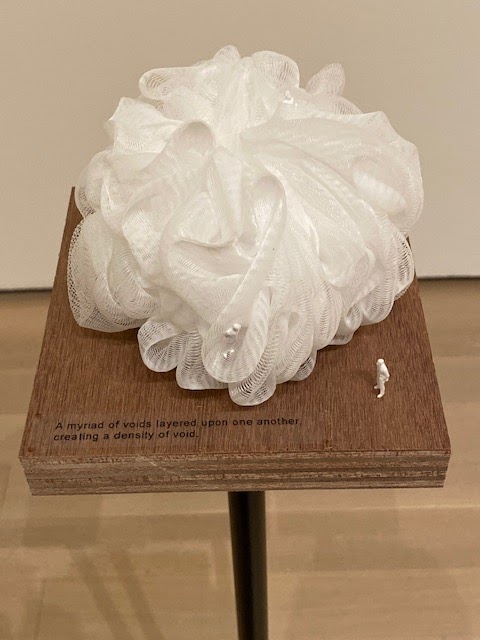
"Fujimoto used unexpected materials to construct 72 miniature architectural models. In them, the architect seeks “a different understanding of nature,” considering the binder clips on our desks, or a stray ping-pong ball, or a sponge by the sink, as significant as the buildings we encounter day to day. Both the play with scale and the surprising appropriation of everyday objects create surreal situations and generate new meanings. Coupled with short aphorisms, Fujimoto’s models invite us to imagine ourselves building and occupying our own complex architectures."
a myriad of voids layered upon one smaller creating a density of  voids
courage
what mistakes did you make last time
you are an engineer
consider different fading systems
remove ambiguities and convert to specifics
we should have a high rise building like this
don't break the silence
you can only make one dot at a time
discover the recipes you are wiring and abandon them
just carry on 
cascades
(organic) machinery
an artificial thing that imitates green might as well open the door to a new possibility of green
use fewer notes
what would your closest friend do
repetition is a form of change
distorting time
give way to your worst impulse
make a blank valuable by putting it in an exquisite frame
the inconsistency principle
it should be possible to make architecture like hills. to be more specific. layering hills is architecture.
what wouldn't you do
is it finished?
decorate, decorate
put in earplugs
give the game away
trust in the you of now
people live in nooks and crannies
balance the consistency principle with the inconsistency principle
fill every beat with something
do nothing for as long as possible
discard an axiom 
listen to the quiet voice
closing and opening. separating and connecting
use and acceptable color
ask your body
humanize something free of error
use filters
between coincidence and inevitability
overly resist change
emphasize the flaws
accept advice
looking for an architectural space in a gap we don't usually pay attention to
consult other sources
do the words need changing
mute and continue
look at the order in which you do things
it is quite possible (after all)
go outside. shut the door
if you think about it. this form has been a friend of architecture for thousands of years.
tidy up 
closed yet open. individuality and continuity.
you don't have to be ashamed of using your own ideas
make a sudden destructive unpredictable action; incorporate
can we see the future of architecture through this mesh? while closing separating and changing like a terrain it is still one surface.
do nothing for as long as possible
bridges build burn
water
a house like bookshelves or bookshelves like a house?
how would you have done it?
honor they error as a hidden intention
emphasize differences
only on element of each kin
the coexistence of simplicity and complexity
don't be frightened to display your talents
use unqualified people
breathe more deeply
architecture is something that always surrounds realms and then opens them.the duality has become a clearly apparent form. coincidentally.
don't be afraid of things because they're easy to do
is there something missing?
the desire to sleep in a bed like this. the desire to live in a house like this. the desire to live in a city like this.
remember those quiet evenings
the richness in architecture is the real world application of Heisenberg's uncertainty principle.
take a break
the tape is not the music 
is this a representation of structure, activity or leisure?
short circuit
imagine the music is a moving chain or caterpillar
use an old idea
is this part of a wall, a house, a city or the earth itself?
intentions - credibility of, nobility of, humility of
destroy -nothing - the most important 
imagine the music as a set of disconnected events
change nothing and continue with immaculate consistency
geometry and disorder. simplicity and complexity. clarity and incomprehensibility.
imagine the piece as a set of disconnected events
what are you really thinking about just now? incorporate
children's voices
assemble some of the instruments in a group and treat the group
here is the flow and coincidental nature of strength and a flickering light. thus here is a world itself.
feedback recordings into an acoustic situation
shut the door and listen from outside
towards the insignificant
complex or simple?
is the tuning appropriate?
simple a matter of work
semi-transparent architecture is something that would probably remain as a dream i wonder when it would be realized?
emphasize repetitions
architecture encompasses nothing. it creates the rise and fall of place.
reverse
abandon normal instrument
different heights are in fact different worlds. a new set of relationships between people.
cluster analysis
work at different speed
do something boring
beyond the myriad of non-architecture related things present how architecture comes into sight. these things are pulling architecture towards this side.
accretion
add people to work against their better judgement
disconnect from desire
take away the elements in order of apparent non-importance
a cave turned into architecture or an ashtray.
infinitesimal gradations
make an exhaustive list of everything you might do and do the last thing on the list
change instrument roles
into the impossible
i like spirals
are their sections? consider transitions
remove specifics and convert to ambiguities
turn it upside down
go slowly all the way round the outside
a line has two sides
 covered space is one of the origins of architecture.
remove specifics and convert to ambiguities
think of the radio
don't be afraid of cliches
allow and easement
what is the reality of the situation
simple subtraction
we should have a highrise building like this.
look at a very small object, look at its center
not building a wall but making a brick
revaluation
disciplines self-indulgence
the important thing is the thing most easily forgotten
always first steps
idiot glee
question the heroic approach
be extravagant
always give yourself credit for having more than personality
state the problem in words as clearly as possible
faced with a choice, do both
tape your mouth 
flows create space. inside becomes outside. outside becomes inside.
twist the spine
get you neck massaged
lowest common denominator check - single beat, single note, single riff
do the washing up
listen in total darkness or in a very large room, very quietly
the forest is always for me the archetype of architecture.
convert a melodic element into a rhythmic element
would anybody want it
spectrum analysis
retrace your steps
go to an extreme, move back to a comfortable place
once the search is in progress, something will be found
only a part, not the whole
architecture is a wrestle with entropy.
from nothing to more than nothing
be less critical more often
don't stress one thing more than another
do we need holes?
look closely at the most embarrassing details and amplify them.
define an area as safe and use it as an anchor
mechanicalize something idiosynchrotic