20 km southwest of Paris, you’ll find thousands of people lining up to tour the palace and grounds. I was shocked by the magnitude of the crowds…. probably due to my lack of interest in walking around a stuffy old palace and my disbelief so many people would find a way to get to Versailles despite the lack of public transportation during the transit strike. To circumvent the lines, we bought time-ticketed entries and decided to roam the gardens and eat lunch. Lunch was the usual… chicken and tuna sandwiches on baguettes. I felt a little grouchy and took solace in cutting several dozen people in line to procure lunch. The grounds were organized around a stately cruciform-shaped reservoir descending from the palace. Walking past conically shaven topiaries, carefully winter wrapped marble statues, manicured lawns, and throngs of tourists taking delight in the resident swans, I began to think how incongruously the turbulent history and drama belie the serenity of the place today.
Back in 1600, Versailles was nothing. Henry IV visited the area and stayed in an inn for hunting. His son Louis XIII built a hunting lodge there in 1623 and decided to build a chateau in 1631. Sun King Louis XIV began embellishing the palace in 1661 by extending grandiose building wings, and laying out gardens, fountains, statues, basins, and even a zoo with exotic animals to boot. For my american readers wondering who gives a fuck about France, in 1783, the Palace was the site of the signing of three treaties of the Peace of Paris which the United Kingdom recognized the independence of the United States. For those morbidly curious about France’s use of the guillotine.... within 6 years, Paris would undergo the start of its own revolution on July 14, 1789. By October 5 1789, a mob of several thousand protesting the high price of bread, marched from the markets of Paris to Versailles. Bloodthirsty, they forced Louis XVI and Marie Antoinette to return with them to Paris where their royal heads were eventually lopped off via guillotine. For those interested in more random useless trivia.... Napoleon, Emperor of the French seized control in the power vacuum in 1804, and considered making Versailles his residence, but abandoned the idea because of the exorbitant renovation costs. The Palace briefly returned to the world stage in June, 1919, when the Treaty of Versailles was signed in the Hall of Mirrors to end the First World War (but start the Second World War by inciting German resentment with its harsh terms).
Thanks, to American philanthropist, Rockefeller, who gave $2,166,000, (thirty million dollars today), to restore and refurnish the palace in 1928, Versailles was saved from shambles. Today, Versailles accommodates 7.7 million visitors a year. At 2:30, we faithfully joined the timed entry conga line through the Palace. There’s nothing worse in visiting a site than being crammed in with thousands of other people. I kept thinking to improve this conga line experience they should play Muzak, encourage people to hold on to preceding visitor’s hips and step to the beat. But I guess, our experience was akin to its heyday, when six to seven thousand persons, crowded into the buildings to keep it running. The crowds made the stuffy palace feel even more stuffy. I admired obscure things like the luxuriant wall paper, noticed how high the kings and queen’s beds were set off the ground, and was surprised Bernini’s sculpture of Louis XIV rested on a mantle. I longed to go back to the landscaped grounds outside… which we did. We walked until the soft yellow hazy sky turned purple blue.
Like aimless cattle, we were herded out en masse to find there were no regional trains from Versaillles to Paris since the transit workers were on strike. With Ubers charging $100 for a ride back into the city, we were resigned to eating in Versailles and waiting for congestion pricing to go down and riding a cheaper cab into town later at night. The kids were a little hungry from a day of strolling Versailles so we got a KFC snack for them— popcorn chicken, juice boxes, and 4 pieces of dark meat. Serendipitously as we were ordering food at KFC, I received a KFC rewards email. Weird. Apparently a guy named Han Low Meng in Singapore mistakenly put my email address for his rewards account by mistake. At the exact moment we were ordering, I was emailed his receipt and a reward for chicken nuggets. “Hi lowmenghan, Thank you for ordering! Here are the details of your order: 3x Original Recipe Chicken 1x Nuggets (3 pcs) 1x Whipped Potato (reg) 1x Pepsi (reg) 2X ORIGINAL RECIPE CHICKEN $ 7.10 1X COLESLAW (MED) $ 3.40 YOUR ORDER : 20191229-000276 DELIVERY DATE : 29 Dec 2019 ESTIMATED DELIVERY TIME : 02:20 PM ADDRESS : 07-325, 82, DEDOK NORTH ROAD, HDB-BEDOK, 460082 PAYMENT METHOD : Cash On Delivery CUSTOMER CONTACT NUMBER : 91759879 TOTAL : $ 26.60.
How does someone with a name low meng han, put down my email address? how are our names even similar? Low Meng apparently ordered a mix of nuggets and pieces of meat, and a couple sides like cole slaw and mashed potatoes and a soda. 10 days later, on January 7th I would receive another set of emails and rewards for chicken nuggets.... he apparently ordered the same food but added 2 egg tarts to this order. By his address and name and his chicken eating habits I have developed a profile of this random person through a little internet sleuthing. Asian, lives in a flat a little east of city center that costs about $300,000, orders more or less the same thing every 2 weeks, could be a lawyer or mechanical engineer based on linked-in profiles. Or maybe he’s a kid playing video games without a credit card and that’s why he pays cash on delivery. He eats erratically either early dinners or late lunches. But I digress. The kids at hand were still hungry despite our order. On the table next to us, a large group had left some pieces of chicken in their bucket along with a empty cups of soda and crinkles napkins and left. My nephew Matt kept joking “should we take the left-over chicken?” I thought young people these days have a strange sense of humor. but being the responsible adult that I am, I joked back, “why not?” It’s a little unusual. Of course the chicken was fine, but eating leftovers from another table is kind of taboo. After a few minutes of deliberations, he and ben ate the chicken out of the abandoned bucket and we left. They told me it tasted a bit stale... as if it had been left out on the table for a prolonged period of time.
We walked back towards the gates of Versailles. There were no taxis. The night sky was pitch black. Earlier during the day, thousands of people lined up in the forecourt to enter Versailles. Now the palace was dark... only a few desperate tourists were left scrambling trying to find their way back to the city. One black cab came by, an initial group balked at the price for a ride back to Paris. 60 euros. When they walked away, we gladly took the cab knowing it was 30 euros cheaper than Uber rates. The driver spoke chinese with a strange accent.... almost stuttering like a shanghainese. It is strange communicating in an unexpected language in a foreign country. My Chinese is limited, but I guess not as limited as my French. In chinese, I’m able to understand and transmit main ideas better.
“We’d like to go to the arc de Triomphe.” “Sure. Have you had a good time in Paris?” “Yes, we’ve seen so much. The Louvre, Pere lachaise, Eiffel Tower, Seine, Sacre Couer, Montmartre...“ “you’ve seen everything... too bad Notre Dame burned down” “Why is there so much traffic?” “The Parisians are returning from their beach cottages in Bretagne...” “they go there in the winter?” “Yes” “you’re lucky because of all this traffic you know. I originally came to Versailles to pick up a customer that I had dropped off from the airport earlier in the day, but the traffic made me late, the customer found another cab to get back to the city.. that’s why I was available to pick up passengers at Versailles late” “do you like Paris?” “Yes, I’ve been living here 25 years” “where did you come from?” “Cambodia” I had no idea France had extended to Cambodia and that Cambodia was integrated into the French Indochina union in 1887 along with the French colonies like Vietnam. In 1946, Cambodia was granted self-rule within the French Union and had its protectorate status abolished in 1949. “Really?” “Yes, I was helping a doctor there and when he returned to France, he offered to bring me, and i took the opportunity.” “It’s amazing you speak all these languages... French, Chinese, Cambodian...” “I had my son learn even more... Korean, Chinese, English, French, Spanish, and Cambodian” “that’s amazing” “it comes in handy for me, sometimes I get customers who pay $400 to hire me to drive them around for the day.” “What do you do with them?” “It’s crazy but rich Chinese love Louis Vuitton merchandise. I drive them to the LV store and they spend $20,000 on a bag, $8,000 for a watch, $5,000 for a wallet… LV limits the customer to 1 bag purchase... so oftentimes I help the buy an extra bag... a couple years ago I knew a worker there, and I was able to help my riders buy up to 5 bags!” As we were pulling up close to the arc nestled in the rich part of town, Trocadero, he warned us to beware of the gypsies. “Last week, I saved 2 old Chinese tourists from being mugged. If you see a gypsy. Just hit them to make them go away. Really. They’re persistent.” “Thanks for the advice.” As we closed the cab door and exited, we left the strange warm bubble that transported us 20 km from 18th century palace to a busy rotary where cars whiz by. Compared to the neat manicured abstract lawns of imperial palace of Versailles, French conquest and colonialism was anything but clean. In its wake, you have the massacres of Bataclan and Charlie Hebdo, very dark skinned North Africans hawking their trinkets outside major tourist sites, Cambodian taxi drivers, and an assortment of amazing Morrocan and Vietnamese restaurants delivering tastes of once-conquered lands...


While she was still a student in college, Maya Lin won the Vietnam memorial design competition for Washington DC. https://upload.wikimedia.org/wikipedia/commons/f/fb/MayaLinsubmission.jpg Her competition entry is unusual in that she spent 1 month on thr design and more than 5 months hand writing an essay which she attached to her boards. Without experiencing war herself, it was amazing 21 year old Maya was able to design a landscape that expressed the feeling of loss from the war. This was a war that America had no reason to fight in. 60,000 Americans died, and countless more Vietnamese died on the other side. It was a ideological failure in that there was no justification for it. Protests about its immorality prompted mass demonstrations in the US during the 1960s. Eventually the losses mounted and America pulled out.
How do you express and respect this tremendous loss of life, and reflect on this deadly politically driven failure? Since there was no glory in Vietnam, Maya left no physical object to represent this war above ground, instead the memorial sits like a scar carved into the landscape. The exposed cut in the land is conceived with a super thin piece of granite polished like a geode. When you first enter, the polished black granite walls are no higher than a sidewalk curb. The names of fallen soldiers are etched into the stone in the chronological order that they fell. As you descend deeper along the ramp by the wall, more and more names fill the walls till you suddenly find yourself at the vertex. This gradual descent mirrors America’s gradual military escalation in Vietnam. At first, the war was a few skirmishes to aid the French... then it gradually became a more entangled gory jungle guerilla battle with viet cong ambushes. At the vertex, the walls reach 10 feet high and you are suddenly surrounded by all the names...it’s overwhelming to see so many names, each one representing a life and dream extinguished too early. Looking through the polish of the stone is like looking into Hades... the dead are within view but cannot escape their fate. Their presence is pressed up against the stone in the form of their names. The reflective quality of the granite is such that you see the reflections of the Washington monument and capitol buildings as you look at the names. The names of the fallen are intertwined with the reflections of the symbols of the American power that sent their poor souls to fight this needless war. I have never experienced such a strong political statement, or spiritual expression of the boundary between life and death.


Dakota building 72nd street and Central Park west (John lennon’s apartment building)
Upon seeing a photo of Yoko’s great grandfather while visiting japan John Lennon said “that’s me in a former life” to which Yoko replied “don’t say that, he was assassinated!” The great grandfather was a powerful banker murdered out of jealousy.
When he was 40, John Lennon was finally starting to come out of seclusion of (in his own words) baking bread and being a house husband. He had spent the last 5 years raising his son, Sean. He wanted to start making music again. to inspire John on his new creative journey, Yoko arranged for Lennon to sail a boat from Newport to Bermuda. Sailing had always been part of his life. His father was a sailor and he had grown up in a sailing town, Liverpool. It was a port where American rock and roll records would come in with the boats. Growing up, his band was inspired by this new music and would listen and emulate American rock and roll legends like buddy holly, the Everly Brothers, Chuck Berry and turn it into something new with an English perspective. When asked how he first learned to create songs, Lennon replied, “first I took a song that I like, then I changed the lyrics, and then I changed the melody for a new song.” while taking care of his son Sean, Lennon would play his favorite songs of theirs in his apartment overlooking Central Park.
On the voyage to Bermuda, Lennon’s boat encountered a tremendous storm. One by one, the crew members went down sick. When the captain asked Lennon to take the helm, he quipped, I only have these puny guitar muscles. He did take the helm and successfully rode out the storm, recounting, “Once I accepted the reality of the situation, something greater than me took over and all of a sudden I lost my fear. I actually began to enjoy the experience and I started to shout out old sea shanties in the face of the storm, screaming at the thundering sky.” Lennon also compared the experience to when The Beatles were at their peak, saying he felt “centered” and “in tune with the cosmos.” An album double fantasy (named after a flower he saw in Bermuda’s Botanical garden) was filled with songs inspired by his voyage and time in Bermuda. He was coming back late to the Dakota with Yoko after recording songs for a new album, when he was gunned down by Mark Chapman... a crazed fan who’d been obsessed with Lennon. Lennon’s prophecy had come true.
Lennon was immediately rushed to st Luke’s hospital on 59th street in a cab. The doctors valiantly tried to resuscitate him, massaging and pumping his heart to no avail. The song that could be heard on the hospital speakers over Yoko’s wails was “all my loving”.
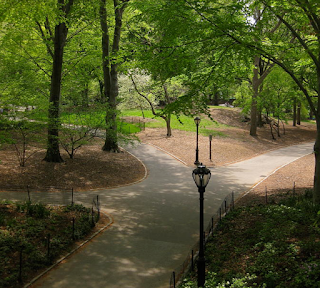
To commemorate his life, Yoko proposed a tear shaped park named strawberry fields that emanates from the intersection of 72nd street and Central Park west and slopes down to the main loop of the park. A black and white mosaic donated by the city of Naples is situated at the center of the tear, with benches around it. Often times you will hear people singing Beatles songs with a guitarist in the background waiting through the air as you pass through. The grades in the park are very gentle. Always curvilinear, you feel them slip into the park. They never seem to end, curves always round hills or mounds so you never know where they lead. A light green patch of sunlit grass draws you in, before you know it, there’s a meadow overlooking skyscrapers, or a playground, or a collection of boulders. Thousands of men and so much dynamite were used to sculpt the land especially at the southern end of the park. It is artificially made nature. The effect of this large human intervention is to create such a natural fluid environment that frees people for activity, contemplation, discovery and delight.
Imagine mosaic (Lennon memorial)
Sitting on the benches by the imagine mosaic, and looking up at the sky through the tall trees, it’s hard to imagine a time when central park didn’t exist. Landscape architecture takes decades to realize... it’s not like architecture where buildings are assembled in a couple years.... it’s a slow art form. Even a complicated project like the Sydney opera house only took a handful of years to construct. A tree may take decades to mature. For this reason, landscape architects must have tremendous vision and foresight. It’s hard to imagine a more unlikely father of Central Park than Frederick Olmsted.
Olmsted was supposed to attend Yale in the 1800’s but a bad case of sumac poisoning in his eyes derailed his college plans. Between sailing to China as a deck hand to failing at multiple attempts at farming to filing bankruptcy for a magazine venture to documenting the daily lives of slaves in the American South as a journalist for the New York Times, nothing in Olmsted’s early life trajectory would’ve suggested that he would go on to change the face of American cities, start the landscape design field profession in America, find success in securing public access to Niagara Falls, and help create one of the first national parks in America, Yosemite.
In August 1857, 36 year old Olmsted found a job supervising a new public works project— Central Park. For 5 million dollars, (or the price of a single luxury apartment lining Central Park today), NYC had acquired 778 acres of land in 1853. The land was filthy and squalid, with the stench of rubbish and pig sties and slaughter houses abound. Rocky, swampy and treeless... one cannot imagine the land would eventually be transformed into Central Park.
Olmsted initially worked under retired military veteran, colonel Egbert Viele who would curiously come to work in dressed in military attire. As you would expect from a military mind, Viele’s plans were very functional but dull. Unsatisfied with Viele’s lack of imagination, the city announced a public competition.
Half dreamer and half pragmatist, Olmsted’s winning ‘Greensward’ plan merged the rational with the poetic. The separation of different modes of traffic was a new concept that Olmsted introduced into the world of landscape park design. First, transverse roads cut into the park in section linking the east side of Manhattan to the west. Second, earthwork berms hid the traffic from the pedestrians above. Third, loops of pedestrian circulation with pedestrian bridges and carriage roads for horses under stone arches interlace the park creating a flowing three dimensional circulation system. As a result, the park is a lot different from the European precedents Olmsted had visited with his father in his 20’s. Instead of formal geometries, Olmsted opted for meadows and woodlands. Central Park was more chaotic than its European counterparts. The pathway design always forking and offering options and different prospects at the horizon reflects a new type of public space, distinctively American and democratic.
To sculpt the land, gunpowder blasting, pickaxes, and horse carts were used to move millions of cart loads of soils. 450 million year old Manhattan schist was exposed, streams, lakes and reservoirs were designed and controlled with an intricate system of piping and valves. The entire nature in the park is like an artificial stage set.
The ambitious project occupied Olmsted’s whole heart. He would remark, “If a fairy had shaped a job for me it could not have fitted me any better. It was naturally outgrown of my previous life history. and it occupied my whole heart.” Olmsted worked himself to such exhaustion that he fell asleep while driving a carriage with his family in the park one day. The accident left him with a leg so badly broken that one of his legs would remain 2 inches shorter than the other for the rest of his life. While he was recovering from his injury, his staff would have to carry him around the park. At times he would crawl on the ground to better survey construction progress. Olmsted maintained that for his designs to be robust, he needed to design with a 40 year outlook in mind. Plants and trees need time to grow in, and new activities are always being introduced to daily life. It’s staggering to imagine that within 150 years of its conception, Central Park has accommodated the advent of cars, recreational sports like basketball, baseball,and tennis, children’s playgrounds, bicycling, electricity and large scale concerts— Olmsted had designed Central Park with such foresight, that it could accommodate all these activities seamlessly.
After Central Park, parks became a central part in American life. Suddenly it seemed every city in America needed a great park came to Olmsted for assistance. Indeed, Olmsted and his sons would go on to transform 355 public landscapes in America including Buffalo, Boston, Niagara, Washington DC. Similar to how Lennon modified American rock and roll music to make Beatles music, (English digesting American culture)... Olmsted adopted formal landscape ideas from England, and transformed the English park idea to become more American . Under his guidance, parks in America became more democratic and open for all people to enjoy. Parks also became more integrated into the city with the 3 dimensional circulation systems and traverse roads. (Integration into cities was further developed in the Emerald Necklace of Boston with the concept of a system of parks integrated into the city, not just one park). This concept of democracy was very important to Olmsted, as he witnessed a lot of injustice in his travels to the south where he observed the effects of slavery and inequality. The democracy wasn’t just limited to races though, when they first started phasing Central Park’s opening, the first attraction that was opened to the public was the pond in the south for ice skating. Ice skating was an activity that both women and men could do together. We take it for granted today, but back then in America it was quite a radical idea that women and men could be equally mobile in public places. (It’s funny women at that time wore such huge dresses they could not tie their ice skate laces by themselves, so there were people by the rinks whose sole job it was to lace women’s skates).
Pythian Building 70th street
The Pythian sits like a sphynx on on 70th street, quite out of character to it's brownstone townhouses of the neighborhood. I walked past this building everyday for 6 years on my way to work before learning of its significance in a newspaper article. In the words of a New York Times architectural historian Christopher gray, "The Pythian Temple’s ground-floor colonnade, with Assyrian-type heads, is centered on a brilliantly glazed blue terra-cotta entry pavilion. The windowless middle section steps back at about 100 feet up, with four seated Pharaonic figures similar to those of Ramses II at Abu Simbel. Two more setbacks rise to a highly colored Egyptian-style colonnade, and to giant urns carried by teams of yellow, red and green oxen." The building was originally designed by theater architect Thomas Lamb to serve as a lavish meeting house for the secret society, the knights of the Pythias established after the civil war. It originally contained a gym, billiards, bowling alley, 13 lodge rooms.
Like the sphynx, the sands of time have cloaked its secrets. For those willing to peel the layers of time from the building, an unexpected reward about it's role in rock and roll history is revealed. (Side note: Before Koolhaas became Koolhaas, he had spent a year researching the history of certain New York City buildings like Coney Island, New York athletic club, and Rockefeller center. His resultant book ‘Delirious New York’ would become the theoretical underpinning of all his later work about urbanism. He studied in depth the adventurousness and craziness of New York architecture, and unpacked it for his own projects). As membership declined, the Pythian building was converted to recording studio. It was the site where bill Haley recorded ‘rock around the clock in 1954.In 1958, buddy holly moved to nyc. Up till then, he had usually recorded in Clovis New Mexico, west of his hometown in Lubbock Texas. He recorded a new song at the pythian in October 1958 with an elaborate orchestral arrangement. that song "true love ways" was intended as a wedding present to his new wife, Elena, whom he had recently married 4 months prior. Two months prior to their marriage they had gotten engaged after their first date! Buddy had been smitten with Elena. within a few hours after he had first summoned the courage to ask music publisher receptionist, elena, on a date, he had proposed and by the end of the night they were engaged. Their wedding kiss picture is mounted on a wall at PJ Clarks restaurant over table 53 at 63rd street in midtown Manhattan commemorating the date.
“Her date with Holly was her first date with anyone, Elena said. When he proposed, she recalled, “I said to myself ‘Is he insane or what?’ I said to Holly, ‘Do you want to marry me now or after dinner?’ ””
Four months after the True Love Ways recording, Holly and Valens, and Richardson went down in a plane crash in the midwest Iowa while touring the Midwest states. it was called the day the music died. holly meant so much to so many musicains. at the nobel literature award ceremony in Stockholm, Bob Dylan, who saw holly in concert on that ‘Winter Dance Party’ tour 4 days before the plane crash recounted, "Something about him seemed permanent and he filled me with conviction,” Dylan said of seeing Holly on stage. “Then out of the blue, the most uncanny thing happened, he looked at me right straight there in the eye and he transmitted something, something I didn’t know what. It gave me the chills.”
In England, holly's music was equally moving to young high schoolers John Lennon and Paul Mccartney. they would skip school to play holly for hours. To the liverpool duo, buddy was unlike any musician at the time. Holly showed them the possibility of writing their their own songs, playing their own guitar solos, creating songs from 3 simple chords, writing their own lyrics and, for John, wearing glasses without being self conscious.. in a tribute to holly, the pair named their band new band the "Beatles" alluding to the buddy's backup band insect name, "The Crickets". up till then john would never wear his glasses in public. He was blind as a bat. McCartney tells a story how one night after jamming guitar together, Lennon walked home without glasses. playing cards story. Mccartney told a story where john told him he was so incredulous that he saw a couple people playing cards outside their house at 11:30 on a winter’s night. The next day, when Paul walked by the house, he realized what John had thought was a card game was actually Christmas nativity scene, Jesus, Mary and the baby lit up on someone's yard! John’s eyesight was so bad he mistook the nativity scene statues for card players! now that john wore his glasses and was able to see.. with Holly’s music in his mind, he was able to see clearly the possibilities of rock and roll music. Their first hit, Love Me Do, was a result of hours of buddy holly jam sessions.