Thursday, December 24, 2020

Tokyo Ride


Certain movies, I fall asleep after the first 10 minutes. Other movies like Tokyo Ride (https://m.imdb.com/title/tt13066868/ I find riveting enough that I can write about them a few weeks later with startling detail.


It’s raining hard on the morning of April 25th. The filmmakers beka and lemoine had planned this meeting for 10 years so rescheduling was not an option. Famed architect Ryue nishizawa pulls up in his Alfa Romeo. He’s dressed in a long sleeve tropical shirt, chill and unassuming. At 43 years old, he was the youngest pritzker  prize winner in the history of the award in 2010.


They cram into the car and start the ride. The subject of the film is a candid impromptu conversation with Ryue over the course of a day. Having learned many lessons in architecture driving Murcutt, I was curious how much there was to learn in driving with Ryue. 


To deal with condensation fogging up his front window, ryue leaves his window gaping open while he drives. His left arm is completely drenched. His European passenger in the rear is soaked. Most people would close their windows and turn on the defrost, Ryue embraced the stormy weather and let it into the car by rolling the windows down.  His driving attitude in bad weather  is consistent with his architectural approach which is open to nature.


As Ryue weaves between lanes on Tokyo highways, he talks effortlessly about ideas of architectural history and cultural theories through anecdotes and conjecture. They ride around the highway which were built over the Venice-like Tokyo canals in the 1960s. “In Tokyo, everyone likes new stuff. There’s no regulations.” Ryue is not a sentimental architect, yet he acknowledges history and tradition. His delivery is matter of fact.  He drives fast but his knowledge of the city is vast and deep. He knows the city and all its layers of history underneath. “I’ve lived my whole life in Tokyo. Spent one month outside Venice biennale.” When they stop at a temple that his ancestors used to attend and where his grandmother was buried, Ryue explains all the superstitions like pacing back and forth in front of the shrine 100 times makes the person’s dreams come true. When asked if he believes in this religious stuff Ryue replies “yes”. 


Since the filmmakers are European, much of the dialogue centers on cultural differences and insights. When the trio talks about driving and cars, ryue opines, “German cars are like machines, you can feel each element distinct. An Italian car is like a living organism.” “What about Japanese cars?” “They’re like computers.”


I found these types of observations fascinating... as they showed ryue’s thinking process. 


“In Europe everyone has to get along with other people... Japan is naive in isolation. In Japan, people are like kids— 15 year olds. They have no armor.”


Feeling hungry, the trio makes a stop at Ryue’s favorite soba shop. They pay special attention about how they make tea out of the soba water and pour them from square ceramic kettles. During the meal, ryue speaks of recent admiration of Candela’s work in Mexico. “Every time I go back to Mexico City i go to Barragan’s house. I’ve been there 10 times.” The noodles are served on flat woven baskets. The filmmakers go to the back of the shop and marvel how the noodles have been made there for generations. 


On the way to a secret destination, beka and lemoine ask Ryue about his favorite architects. Ryue responds with 3. “corbusier was the greatest. He was the  ‘adder’. He knew how to put new architecture on top of old. Mies van der rohe built architecture for Kings every detail unique. When I asked Oscar Niemeyer who his favorite architect was, he said ‘my brother’ cause he was communist” 


The surprise destination they arrive at is Seijima’s house. Seijima is the architect ten years senior who he partnered with in the 1990s. Now middle aged, Seijima recounts how they used to fight all the time. “Before we fought. now we don’t fight. people assume we’re the same. We’re not. I’m more structural he’s more emotional. Now we’re old and  tired and don’t fight anymore.” 


Seijima’s house was designed by  ryue. They fought all the time over the house design initially. Seijima would say, “ I don’t like this drawing, why don’t you draw it like this? Then when he drew it the way I wanted, I asked ‘why did you draw it the way I told you?’ For one year the design of the house was debated till finally seijima relented and let Ryue design the house. Seijima’s mom was supposed to live there. By she didn’t. A small altar with a picture of her mom sits by a wall. She looks startling similar to her mom.


In the house, plants abound. Seijima admits she spends all day at the architecture studio and only comes home to sleep. 


With seijima in the car, the group drives to SANAA’s office. When you enter the office, a walkway is flanked by plywood bookcases. You walk through a slot to the back  where there is a larger communal space, seijima’s desk and daybed. Huge models they work on are seen everywhere.  Seijima admits she sleeps on the daybed during the day to refuel. She probably spends 16 hours a day working in the studio. Having seen their airy work like the new museum and River building, it’s interesting to contrast the studio where their architecture is dreamed up and their work. 


Leaving seijima at the office ryue takes beka and lemoine to kenzo tange’s Olympic stadium. He reminisces how his father would take him swimming there as a kid. “The stadium is amazing in that it is naturally ventilated. In high school I saw Springsteen, Dylan, Rolling Stones concerts here. It also is striking in its dialogue with eero saarinen’s structures. They were influenced by each other before the age of the internet. Somehow the conversed yet they were on opposite sides of the earth.”


Continuing about his childhood, ryue recounts the wonder he had attending a summer camp as a kid. “The sleeping dorm was separated from the toilet facilities. At night you had to walk across the field to get to the toilet and on the way you could see the whole Milky Way.. all the stars.” It was these types of experiences that would help formulate his ideas of the moriyama house... the last scene of the movie. 


the kind of life that mr. moriyama has in that house it is totally related to the feeling ryue felt when he was in camp as a kid. In the final scene, moriyama, beka as lemoine and ryue eat sushi on the roof of the house. Ryue explains the logic of the house. “Designing a house you think of all the things that can happen in there.  moriyama has a bedroom that is separate from the bathroom, from the kitchen, and from the rest of the house. To go from one room to another Moriyama has to go outside. in the summer it’s very hot, and in the winter it’s very cold, but he has to go outside to live. he lives in a house that is outside and inside.”


To analogize his house to culture, ryue explains “China and europe are like nouns. They are very stable civilizations rooted in permanence. Islands in the Asia like japan and Indonesia are like verbs. They and their architecture are like waves and movement." 


After watching the movie I had the sense that the story told by European filmmakers covering a renowned Japanese architect had the right balance of verbs and nouns to paint a portrait of a man, his culture and his architecture.


Friday, November 27, 2020

Forays in Freelance


So I’ve shaved twice since June for the same woman, S.. There was an ad for a high end residential architecture position that I applied to in September. The call was short and rushed. She seemed disinterested. I immediately regretted shaving for that zoom call interview.

For a month I lamented shaving off my beard especially since S. didn’t call me back. I had found some weird comfort in tugging at my beard. Just when my beard started sprouting again, S. emailed again for an unexpected follow up interview at the end of October. I debated whether to shave it off again. I lost my hard earned beard and had no job to show for it after the first interview. But again, I succumbed to societal norms and shaved off my beard to try to get the job.

For the second zoom interview, she saw that I had shaven and asked whether I was still interested in the job. I said yes. She asked me to meet at her office. 3 days later I biked across the bridge in the rain (since covid still lingers in the subways) to her office in queens to assess the situation. She was 4 years younger than me... overwhelmed with too much work. I was 4 years older than her, parking my car on alternate sides of the street. We made a great pair. The project she was hiring for was a town home renovation. I had no experience in this type of work. An addition to the top and back of an existing townhouse building in Brooklyn.

She handed me a hard drive, a computer, a stack of drawings and most importantly 3 stapled sheets of department of building objections to her project. We agreed that I wasn’t a full employee, that I would be working on an hourly wage. This gave her flexibility to fire me if I did an incompetent shit job and gave me flexibility to leave hastily if my library project is ever resurrected. I assured her even though I have no experience, i work super fast and I have plenty of construction wisdom to draw upon. I said a lot of things in my interview to try to get hired.

For a building to start construction, it needs to pass city bureaucratic reviews and plan examiner approvals. For the past 2 years I’ve handled this aspect of architecture ad nauseam. for a mental clinic, then an apartment building, then a library... but now this was my first foray into obtaining code approval for residential work.

A week into the project I realized architecture is architecture. Whether you’re drawing a library or a house, to do a good job you need to, as they say in baseball, “play the game the right way”. In baseball when you get a hit, you run hard to first. When you play defense you always get in position to make a play. You don’t loaf around. Glenn Murcutt would call this ‘play the game the right way’ mentality in architecture, morality. For him, when you have a client, you focus 100% on the project, you try your hardest to define and solve problems and you don’t compromise or slack off. If you don’t have this commitment as an architect, Murcutt advises you should go into accounting. “The hours are better and you get paid more.”

The condition of the drawings I inherited for the townhouse were dismal, sloppy, and disorganized. The cross sections were not coordinated with the survey. The existing plans didn’t relate to the elevations. The roof and stairs did not comply with safety and environmental code mandates. The proposed designed walls had no element of reality or constructability. The structure was designed for 4” thick brick, whereas the design assumed 1/2” thick brick. The facade was not based on the module of its material (brick). The mechanical system developed did not fit within the ceiling heights given and would’ve resulted in 5.5 foot tall ceilings. I had enough experience to quickly recognize the game had not been played the right way for this townhouse project.

My initial efforts for the project focused on setting up the drawings. I set the plans up so they could all be overlaid. This is a little tedious to do, but because the proposed townhouse has 6 levels... it is imperative to be able to see all six levels simultaneously. This helps to line up stairs and plumbing lines, mechanical ducts and structure.

The original building was made to codes from the 1930s. Since we were doing alterations whose value exceeded 30% of the value of the property the building had to follow the 1968 code... but we opted to use 2014 codes since we’re designing in 2020 to take advantage of specific provisions. Capishe? Each code has its peculiarities. For 1968 codes, the stairs can be narrower and steeper, but they have to be non-combustible construction (i.e., steel) and you can’t have a continuous run of stairs beyond four stories without enclosing them. In the 2014 code, the stair must be 3’-0” wide, riser heights are limited to 8.25”, the stair has to exit on the roof through a bulkhead, and the building has to have a sprinkler system but you can have a continuous stair rise all the way up a residence without enclosing walls. Technically, once you select a code, everything in the building should be consistent with that code.

The townhouse is rather narrow at 16’-0” wide so fitting the stair was a challenge. The existing stairs were 30” wide, made of wood, and very steep. Since the building was made prior to 1968, its wood stairs were grandfathered in under previous codes. Ideally from the cellar to the 3rd floor we wanted to keep the existing stair compliant to 1968 code to avoid the expense and complications of replacing it with an enlarged 36” wide steel stair, yet we wanted to present the entire stair as 2014 code compliant to have it rise up the building without enclosures, and build the upper floor stairs out of wood.

I brought up this dilemma of jumbling 2 codes to our advantage with S. She introduced me to J., an expeditor whose sole job it is to gain regulatory approval for building projects. She warned me this guy is a little strange. He works at odd hours through the night. He’s an old man who works regulatory magic from his studio. On Thanksgiving he emailed me at 3:37 AM and then we had long conversations and traded obtuse emails and esoteric sketches throughout this day Americans usually set aside to celebrate family. Forget the turkey, we had to figure out how much of the sidewalk and pavement to repave or how large the opening to the alcove was to comply with code regulations, etc...

S. told me she never joins these conference calls with the building department since she feels she can’t provide any value. I join these calls to learn the art of regulatory finesse and because I have nothing better to do now.

When facing alterations to buildings existing buildings that straddle multiple codes, I found the codes are open to interpretation. There is no black and white. An architect and expeditor make their case to plan examiner and the examiner makes a judgment whether to accept or not accept the design. Over the past month I’ve had weekly meetings with J. Our plan examiner A. was not very sharp. He didn’t seem to know the codes himself and spent time on the conference calls looking up various sections to understand the code to check things. Sometimes he would ask his boss to join him, who was equally muddled in the head confusing codes from different eras like an Italian trying to speak French in Spain.

To achieve our goals, J. advised me to not show any dimensions for the existing stair. And to simply label the existing stair to remain. If we don’t bring attention to the fact that it is not code compliant to 2014, and the examiners don’t object to it, it can get approved. really? As architects, we rationalize in a house with a sprinkler system, the stair would be safe, regardless.

In these department of building sessions while the plan examiner asked questions about the stair’s combustibility, landing dimensions, etc.. he never once asked for the dimensions of the existing stair to remain. It was terrifying to sit on the conference call while the examiner was sifting slowly through the drawings... at any given point he could’ve asked the most obvious question... “is your whole stair 2014 compliant? Or how wide is the stair there?” And we would’ve been forced to make a new stair that would have had huge spatial and financial impacts. J. and I were like 2 criminals in the bushes looking at a detective at a crime scene who didn’t see the murder weapon in plain sight. This was suspense at the highest degree at a plan examiner meeting.

Sunday, October 11, 2020

Tennis Anyone?

I’ve learned a lot of life lessons this past year. Like when you mount a bike rack to the back of your car, let the foamed bottom arm of the rack rest on the license plate rather than the body of the car. Apparently, the license plate area of the car body is structurally reinforced and can withstand the weight of bouncing bikes-- the other parts of the car body not so much. Within a week of buying our car and schlepping our bikes on a mispositioned bike rack over bumpy roads to Cape Cod, I noticed an irregular large dent below the license plate that made the car look 10 years older. It’s annoying to drive around in a newly bought damaged car, especially when the damage is self-inflicted but I figured these disfigurations were cosmetic only and not worth the hundreds of dollars it would take to fix it in a shop. To add insult to injury, over the past couple months of parking on nyc streets, like a moon marred with craters, the car has accumulated a multitude of miscellaneous scrapes and damages that have further escalated its devaluation.

Within the brown colored dented and scraped car I sat double parked waiting for alternate side parking on Friday. Much of life in NYC still remains impacted by corona. In the new normal, I haven’t taken the subway since March nor have I worked a minute in architecture since mid June. Theater, sports, and concert venues are still closed. The only thing that seems to be thriving is outdoor dining. Without safe indoor spaces to eat, restaurants have taken over parking spaces in the street for their tables and chairs. All these covid changes make parking more difficult.

After a couple months without street cleaning, alternate side parking returned to NYC late in the summer. It used to be that on Monday and Thursday a white Zamboni-like street cleaning vehicle would sweep the north sides of streets, and on Tuesday and Friday the Zamboni would alternate and clean the south sides of streets. Nowadays the city only cleans the streets 2 days a week - the northsides of streets on Thursday and the southsides on Friday. For those without experience alternate side parking in New York, it is like a game of high stakes musical chairs except no music or chairs. With more demand than supply, you have a surplus of cheapskate car owners like me vying for limited street parking after scheduled weekly street cleanings. If a street is supposed to be cleaned between 11-12:30 pm on Friday, people sit double parked in their cars on the north side of the street and wait for the street cleaning vehicle to pass before parking on the south side. Even if the street has been swept cleaned you can’t leave your car within the weekly alotted street cleaning time because police officers are liable to issue a ticket for unattended cars. People spend 90 minutes shifting their vehicles in this weekly car parking ritual.

If you don’t find a parking spot during street cleaning times, you’re like a lost soul left to circle around the streets till someone leaves. It could take hours to find a spot. In foraging for parking spaces, I’ve noticed building contractors usually vacate their spaces around 4 pm, teachers leave their designated school spots at 5pm, and vans at the farmer’s market in front of the American Museum of Natural History leave at 6pm on Sunday. You start noticing these things about the neighborhood when you’re cheap, unemployed, and looking for parking.

As I was waiting in my car continuing my Jane Jacobs urban analysis of the neighborhood, a gray pickup truck passed by and the driver inquired whether I’d like a quote to fix the dent on the back of my car.

“Sure” I replied, I had 90 minutes to waste.

He pulled off the side of the road and came by to explain his offer.

“I’m Jack.” He puts his fist out for a bump to initiate a handshake free covid salutation. “I’m in the neighborhood fixing cars for people who can’t bring their cars to the garage in the pandemic. I can give you a quote for the repair.”

“Where’s your garage?”

“28th street, but I can fix your car here.”

“Here?”

“Yes.” He started walking around the car and taking inventory of all the nicks and dents. After a survey of the damage he said, “I’ll charge you $200 cash. I can fix the dent on the back by pushing it from the inside.” In his hands he held an assortment of suction cups, mallets and wrenches.

“Cool.” For $200 I thought it was a steal. Bring the car to a garage, and they would probably charge $500 minimum. The car was already fucked up so I wasn’t too worried he would mess it up more.

As Jack was working on my car, the driver from the car behind mine approached me all curious about the in-situ repair. He looked and sounded like Larry David but was named Steve. It’s not everyday you have your car repaired on the street during alternate side parking.

After asking me about the repairs, Steve asked how long I lived in the area, I told him I’ve been here 25 years, and pointed to the building I lived in across the street. When he asked what I did for a living, I bluntly replied “tennis… actually I play tennis all the time because I lost my job in architecture. Our firm had 3 libraries and a poet’s cafĂ© but then all our work was wiped out due to covid. Usually it’s embarrassing to reveal you’re unemployed... a sign of weakness that nobody finds you worth hiring. After looking for 4 months for a job without success, I’ve become quite good at tennis. I can rally for extended periods of time and position the ball anywhere on the court at will… so when Steve asked me what I do, I replied with my current strength: tennis.

Steve, unexpectedly revealed he too is also an avid tennis player and has played all summer on Fire Island. Interesting. He asked me to guess his age. He was spritely. I guessed 65. He said 77. He then said “I may look old, but I’m probably the best old person you’ll play at tennis. I play on clay because it’s easier on my joints, and I can’t run, but I’m good.”

“Cool.” I told him we could play in central park or riverside park one day and traded phone numbers.

When Jack finished working on my car, he started talking to Steve and recommending fixes to Steve’s Lexus. They circle around Steve’s car. For $100, he touches up the paint on Steve’s car. I continue talking to Steve while all this repair work is going on.

Steve excuses himself while he takes a call. It’s a woman out in staten island. Apparently he got involved with democrat Afgan war vet Max Rose’s election campaign, and he talks to fellow volunteers in public relations plotting to help regain democratic control of the house in NY state. I asked him what his profession was thinking he was in advertising. Steve replies “real estate developer… but I used to be a psychoanalyst.”

Thinking this conversation may now lead me to a job, I start asking him what kind of buildings he develops.

“Mixed use, retail and housing.” He responds. “We started buying property in the lower east side and flipping them.”

“Really? I worked on a building at Essex Crossing”

Steve says, “My office is a block away from Essex Crossing. What kind of work do you do?

“Schools, housing, university projects.”

“Do you file jobs with the department of buildings in the city?”

“Yes. I spent much of the past year dealing with city bureaucracy and filing building applications for my designs.” Filing with the city is tedious I think to myself, is this what my career has come to? Conversations about filing to drum up work from random alternate side parkers?

Jack was now finished with Steve’s car. I hand Jack $200. He pockets $100 from Steve. Overhearing our political conversation, Jack now rants, “Our country is too divided now. People today are too thin skinned. Kids are spoiled. Before we used to eat whatever you were given. We ate all sorts of offal, it’s what our family could afford. Nowadays kids have too many choices. One kid is eating pizza, another one eats a hamburger… kids used to play on the street. When I grew up as a Russian Jew in Coney Island, we had to get along with the blacks in the neighborhood. Kids went to the playgrounds to socialize, to learn how to navigate cultures and live with people of different backgrounds and cultures…”

When Jack leaves, Steve and I thank our good fortunes finding a skilled car repairman off the street. Minutes later into our conversation, a building superintendent came down the street and remarks, “isn’t that guy the worst? He’s like a Gypsy. He does bad work and make $200 here $100 there. He’s so rich he drives a Mercedes.”

Steve and I look at each other and think if we were fleeced. We then rationalize to ourselves if we had taken our cars to a proper auto mechanic’s garage the repairs would’ve cost well over the $300 we paid. In the end we were happy with Jack’s work.

What started as a mispositioned bike rack, led to an unsightly dent and then a repair that spurred a conversation of tennis, politics, and potential future architecture work.


Sunday, September 27, 2020

Voyage d'Orient - Corbusier

 At the age of 23, Corbusier embarked on his Voyage d’Orient (click here for voyage d'orient) -- a seminal 6 month trip that took him from his home in Switzerland through Italy, Greece, Turkey and the Balkan States. His boyhood teacher at art school, Charles L’Eplattenier discouraged Corbusier from following his father and grandfather’s watchcase engraving career paths since it was a dying art. Instead, L’Eplattenier advised Corbusier to trace architecture’s origins to the East and helped him develop the itinerary for the trip. Like Frank Lloyd Wright and Mies van der Rohe, Corbusier did not have formal training in architecture. He used his observations, writings, and drawings from his travels to inform his ideas and develop new approaches to architecture. Throughout his career, Corbusier repeatedly mined his travel sketchbooks for ideas in writing and architecture. After his death, in 1962, the sketchbooks from his trip were published.

In my studies in school, my history of landscape architecture professor advised me to look into Corbusier’s Voyage d’Orient travels. So far, I’ve only visited two meh Corbusier buildings, the Carpenter Center at Harvard and the United Nations and his urban planning principles have been devastating to the American landscape. But his writing on the other hand, like “Towards a New Architecture” and “Le Modulor” I find inspiring. They are instructional in how to make architectural arguments and develop theories.

During my architecture fellowship after school, I focused on Corbusier’s travels through the ancient ruins of Rome, Pompeii, Greece, and Tuscan monasteries and their impact on his spatial planning and housing in particular. I thought, in looking at what Cobusier looked at, I may become similarly inspired and the trips would propel my career to amazing heights. Things haven’t turned out as expected. While I remain gainfully unemployed, I will flesh out my ideas about Corbusier and his Voyage. After 16 years, my sketchbooks collected dust but now, I will start resurrecting them to make comics.

In returning to my research into Corbusier I was surprised to find out 2 facts. First, his architectural education came from his travels and two, Istanbul was the main interest in his Voyage d’Orient. He devoted 50 days of his 6 month sojourn there. I was so focused on Roman and Greek precedence that Corbusier looked at that I missed out on Turkey.

Corbusier was so impressed by Turkey, that one of his first houses he made in Switzerland after his trip was nicknamed the Turkish villa. When he offered his urban planning services for free to Ataturk in 1936, he proposed to retain the historical character of Istanbul, (click here for Corbusier's big regret) rather than raze it like his 1925 Plan Voison for Paris.(click here for the disaster that was luckily avoided Corbusier lamented he should have been less sentimental for his Istanbul planning efforts to gain the position of urban planner under the Turkish revolutionary. 

When Corbusier arrived in Istanbul, the simple modular cube/sphere geometry of the mosques that were aligned to Paul CĂ©zanne’s analysis of forms: "We must treat nature according to the cube, the sphere and the cone.”


Corbusier on Voyage

Corbusier watch engraving efforts pre-architecture


Saturday, September 26, 2020

Corbusier's Apartment - Part 1 the Painting Studio

I’ve seen countless famous buildings by Corbusier in books, but I was not aware of his apartment in Paris. In speaking of his apartment, Corbusier remarked it was, “A home that is heavenly because everything is sky and light, space and simplicity.”

Situated across the Bois de Boulogne and the Roland Garros tennis stadium, Corbusier designed the building for a private developer. Conceived to take in sweeping views of Paris, it was the world’s first residential building facade made completely of glass: reinforced glass, glass bricks, and clear glass. Corbusier moved into the penthouse duplex unit at 24 rue Nungesser et Coli in 1934 with his wife, Yvonne and dog Pinceau and lived there for the remainder of his life till 1965. Unfortunately for Yvonne, the amount of glazing was overwhelming and she reportedly complained, "all this light is killing me... driving me crazy."

Despite the spousal complaints, the apartment appears to be a modern masterpiece. Upon closer inspection, however, you can see how Corbusier translated ideas from his early travel experiences (Istanbul, Rome, Pompeii) into built form. To show how these ancient influences are woven into his work, I’ll provide excerpts from Cobusier’s book “Towards A New Architecture” in orange and interleave them with my insightful Beavis and Butthead commentary which will be organized around the notion of the “architectural promenade”.

The architectural promenade, or interior circulation was an obsession Corbusier engaged in throughout his entire career: “Everything, especially in architecture, is a question of circulation”... “Arabic architecture teaches us a valuable lesson. It is best appreciated on foot: it is by walking, by moving that one discerns the underlying architectural arrangement. This principle is exactly the opposite of baroque architecture”

To develop a successful architectural promenade, Corbusier believed three essential ingredients were necessary: first, the entrance has to whet the visitor’s curiosity and entice him to follow the determined path; second, the path must accommodate multiple, successive points of view; and third, the diverse components of the promenade must form a cohesive architectural whole. For this project, Corbusier created a set of key vignettes showing his early ideas for views of the promenade going through his apartment. 


Early facade sketches

Choreographing the architectural promenade


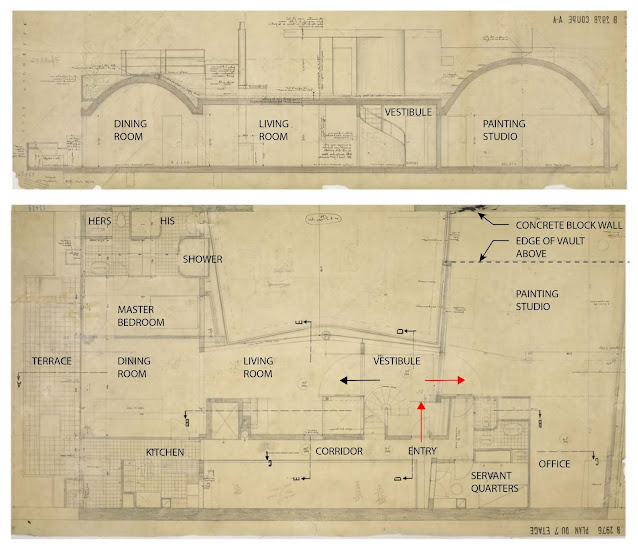
Apartment duplex lower floor plan and section.


The Entrance
Approaching the building from the street, one sees the standard hallmarks of Corbusier's buildings, piloti (grid of concrete or steel columns that replaces the load-bearing walls), roof garden, flexible plans allowing users to adjust their interior wall positions, expansive horizontal ribbon windows, and a free facade. 


The entry to his apartment is through a modest door in a skinny corridor. Immediately upon entry, a small low space with a spiral stair ascending to the light is analogous to entering the greeting atrium of a Pompeii house.

From Towards a New Architecture - "Casa del noce at Pompeii. Again the little vestibule which frees your mind from the street. And then you are in the atrium; four columns in the middle shoot up towards the shade of the roof, giving a feeling of force and a witness of potent methods; but at the far end is the brilliance of the garden seen through the peristyle which spreads out this light with a large gesture, distributes it and accentuates it, stretching widely from left to right, making a great space. Between the tow is the Tablium, contracting the vision like the lens of a camera. On the right and on the left two patches of shade -- little ones. Out of the clatter of the swarming street which is for every man and full of picturesque incident, you have entered the house of a Roman. Magistral grandeur, order, a splendid amplitude: you are in the house of a Roman. What was the function of these rooms? That is outside the question. After twenty centuries, without any historical reference, you are conscious of Architecture, and we are speaking of what is in reality a very small house."

casa del noce


Oversized large pivot doors open up to the studio to the right and living room to the left. Whereas the entry area and living room have low flat ceilings, the art studio space soars into a surprising barrel vaulted space 6 m wide, 12 m long and 3.50 m high with windows overlooking the street. At the end of the studio, the barrel vault is held back revealing the party wall, the rough concrete block and brick wall of the neighboring property that Corbusier left exposed like an abstract canvas. Of this wall, Corbusier wrote : “Stone can speak to us; it speaks to us through the wall. Its covering is rough yet smooth to the touch. This wall has become my lifelong companion.”

Corbusier in action

barrel vault terminted in front of concrete block party wall left, casa del noce right. notice how corbusier lights the wall with high windows like the Pompeii House wall. both walls have a similar appearance.

The conceptual treatment of the concrete block wall is similar to Pompeii house walls. Our elements are vertical walls, the spread of the soil, holes to serve as passages for man or for light, doors or windows. The holes give much or little light, make gay or sad. The walls are in full brilliant light, or in half shade or in full shade, giving an effect of gaiety, serenity, or sadness. Your symphony is made ready. The aim of architecture is to make you gay or serene or sadness. Your symphony is made ready. Have respect for walls. The Pompeian did not cut up his wall spaces; he was devoted to wall spaces and loved light. Light is intense when it falls between walls which reflect it. The ancients built walls, walls which stretch out and meet to amplify the wall. In this way they created volumes, which are the basis of architectural and sensorial feeling. The light bursts on you by a definite intention, at one end and illuminates the walls. There are no other architectural elements internally : light and its reflection is a great flood by the walls and the floor, which is really a horizontal wall. To erect well lit walls is to establish the architectural elements of the interior. There remains to achieve Proportion. 

The studio space was divided into three sections. The largest section was for painting. Since the site is oriented East-West, corbusier couldn't design the studio with north facing light. Instead, Corbusier chose clear glass and glass bricks to diffuse the light evenly throughout the space. Tucked in the corner of the studio was his office, the desk where he wrote his numerous books. Corbusier didn't like clutter, so he thickened his walls between rooms for storage. The wall between the office and studio is essentially a library bookshelf which contained Corbusier's own writings (he authored 40 books), technical manuals and classics. The third section was for the servant and storage space.

Looking at the workspaces you can imagine how Corbusier spent his mornings painting, then retreating to his desk to write and draw. The spaces were designed for maximum creativity. According to former coworker Jerzy Soltan, Corbusier's schedule was highly regimented. "at 6 A.M., gymnastics and …. Painting, a kind of fine arts calisthenics; at 8 A.M., breakfast. Then Le Corbusier entered into probably the most creative part of his day. He worked on the architectural and urbanistic sketches to be transmitted to us in the afternoon. Outlines of his written work would also be formulated then, along with some larger parts of the writings. Spiritually nourished by the preceding hours of physical and visual gymnastics, the hours of painting, he would use the main morning time for his most inspired conceptualization. A marvelous phenomenon indeed, this creative routine, implemented with his native Swiss regularity, harnessing and channeling what is most elusive. Corbu himself acknowledged the importance of this regimen. “If the generations come”, he wrote, “attach any importance to my work as an architect, it is to these unknown labors that one as to attribute its deeper meaning.”“After everything is said and done, I am a painter, and fervently so, since I paint everyday. It’s true that I began late in life, suddenly at the age of thirty-three… I would spend the morning painting and, in the afternoon, on the other side of Paris, devote my efforts to architecture and urbanism. Can we measure to what extent this patient and obstinate gardening, plowing, hoeing of forms and colors, rhythms and proportions, nourished the architecture and urban plans born each day at 35, rue de Sèvres? I think that if some value is to be accorded to my work as an architect, it is on this secret labor that the underlying quality depends.”

“I am a painter, basically, with tenacity, since I paint every day. In the morning, it’s painting, in the afternoon, on the other side of Paris, it’s architecture and urban design”, he observed. As he believed that his very persistent research was indeed the secret of its virtues as an architect. No one is just a sculptor, or just a painter, or just an architect. Artistic creation is carried out in the service of poetry.”


view towards office section of studio

office area with shelf storage as thickened wall
view looking back towards entry vestibule. wooden interior screens allowed corbusier to block glare


Friday, September 25, 2020

Corbusier's Apartment - Part 2 Learning from Pompeii

Walking from the painting studio towards the living room is like stepping back into the ancient past. Strip away the steel, concrete, and glass of Corbusier's apartment and you essentially have a house that is Roman in organization and conception. In a typical Pompeii house, all public rooms of the house are on axis. Sculptural elements like shrines and fountains are placed within these rooms off center in dynamic positions. Diagonal expansive views open up as one walks through the spaces. In Corbusier's apartment, the east-west axis skewers all the public functions of the house like a shish kebab - the painting studio, vestibule, living room, dining room, and terrace are all lined up. As one enters each room along the axis, spaces open up multiple unexpected dynamic diagonal views. The sculptural forms of the stair, fire place, library shelf, and dining table give each space a focal point. 


In his Voyage d'Orient writing and sketches made in 1911, Corbusier distilled the essence of the Roman house axis and focal points succinctly. 23 years later he would base his own apartment design on these ancient ideas.  "An axis is perhaps the first human manifestation ; it is the means of every human act. The toddling child moves along an axis, the man striving in the tempest of life trace for himself an axis. The axis the is regulator of architecture. To establish order is to begin to work. Architecture is based on axes. The use of the schools are an architectural calamity. The axis is a line of direction leading to an end. In architecture, you must have a destination for your axis. In the schools they have forgotten this and their axes cross one another in star shapes all leading to infinity to the undefined, to the unknown, to nowhere, without end or aim. The axis of the schools is a recipe and a dodge.

Arrangement is the grading of axes and so it is the grading of aims, the classification of intentions. The architect therefore assigns destination to his axes. These ends are the wall (the plenum, sensorial sensation) or light and space.

In the house of the Tragic Poet we have the subtleties of a consummate art. Everything is on an axis but it would be difficult to apply a true line anywhere. The axis is in the intention, and the display afforded by the axis extends to the humbler things which it treats most skillfully by optical illusions. The axis here is not an arid thing of theory; it links together the main volumes which are clearly stated and differentiated one from another. When you visit the House of the Tragic Poet, it is clear that everything is ordered. But the feeling it gives is a rich one. You then note clever distortions of the axis which give intensity to the volumes; the central motive of the pavement is set behind the middle of the room ; the well at the entrance is at the side of the basin. The fountain at the far end is in the angle of the garden. An object placed in the center of a room often spoils the room, for it hinders you from standing in the middle of the room and getting the axial view ; a monument placed in the middle of a square often spoils the square and the buildings which surround it- often but not always. Arrangement is the grading of axes, and so it is the grading of aims, the classification of intentions.

view through large pivot doors back towards entry vestibule


house of tragic poet axis

notice the fountain positioned off center

shrine off center resembling corbusier's fireplace...


To give the architectural promenade through the house axis a sense of richness, Corbusier deployed a rhythm of light and space reminiscent of the the light and dark sequence of spaces of the mosques of Istanbul and houses of Pompeii. 

In "Towards a New Architecture" Corbusier opines, "A building is like a soap bubble. the bubble is perfect and harmonious if the breath has been evenly distributed and regulated from the inside. In Broussa in Asia Minor, at the Green Mosque, you enter by a little doorway of normal height; a quite small vestibule produces in you the necessary change of scale so that you may appreciate, as against the dimensions of the street and the spot you come from, the dimensions with which it is intended to impress you. Then you can fell the noble size of the mosque and your eyes can take its measure. You are in a great white marble space filled with light. Beyond, you can see a second similar space of the same dimensions but in half light and raise on several steps (repetition in a minor key); on each side a still  smaller space in subdued light; turning around you have two very small spaces in shade. From full light to shade, a rhythm. Tiny doors and enormous bays. You are captured, you have lost the sense of the common scale. You are enthralled by a sensorial rhythm (light and volume) and by an able use of scale and measure, into a world of its own which tells you what it sets out to tell you. What emotion, what faith. There you have motive and intention. The cluster of ideas, this is the means that has been used. In consequence, at Broussa as at Santa Sophia, as at the Suleiman Mosque of Stamboul, the exterior results from the interior."


The dark low ceilinged living room space is punctuated by a skylight that accentuates the red fireplace wall. Of color, Corbusier remarked, "Blue and his green mixtures create space, create a sense of distance, create an atmosphere, push the wall into the distance, making it palpable, depriving it of the quality of firmness by creating a certain airiness between the wall and the viewer. Red fixes the wall, affirms its exact location, its dimension, its presence." For an architect who painted every morning and left architecture for 4 years to paint (1917-1921), Corbusier took color selection very seriously. In fact he developed a color palette system for his architecture.

Describing his color system, Corbusier notes, "These Keyboards of Colour aim at stimulating personal selection, by placing the task of choosing on a sound systematic basis. In my opinion they offer a method of approach which is accurate and effective, one which makes it possible to plan, in the modern home, colour harmonies which are definitely architectural and yet suited to the natural taste and needs."

Corbusier's Architectural Polychromy palettes contains 63 shades that Le Corbusier created in two colour collections – in 1931 and 1959. All shades are architectural, annotated by Corbusier, naturally harmonious and combinable. Each hue has its relevance and embodies specific spatial and human effects. (click here to see Corbusier's color system)

Hopefully for a lazy color challenged architect like me, using his color palettes on projects will prevent future color catastrophes. For an ambitious Roman inspired architect like Corbusier, setting up standards for color palettes was a natural endeavor in his quest for perfection. In his career, Corbusier emulated the Romans' effort (documented by Vitruvius) to standardize everything from dimensions to proportions to housing to materials to urban plans. Whereas the Romans were seeking the efficient world domination through standardization, Corbusier was interested in harnessing quality design through the power of standardization of modern industrial mass production. 

"Architecture is governed by standards. Standards are a matter of logic, analysis and precise study. Standards are based on a problem which has been well stated. Architecture means plastic invention, intellectual speculation, higher mathematics. Architecture is a very noble art. Standardization is imposed by the law of selection and is an economic and social necessity. Harmony is a state of agreement with the norms of our universe. Beauty governs all ; she is of purely human creation ; she is the overplus necessary only to men of the highest type. But we must first of all aim at the setting up of standards in order to face the problem of perfection." 

"A standard is established on sure bases, not capriciously but with the surety of something intentional and of a logic con- trolled by analysis and experiment. All men have the same organism, the same functions. All men have the same needs. The social contract which has evolved through the ages fixes standardized classes, functions and needs producing standardized products."

"We must aim at the fixing of standards in order to face the problem of perfection . The Parthenon is a product of selection applied to a standard . Architecture operates in accordance with standards. Standards are a matter of logic, analysis and minute study : they are based on a problem which has been well “stated.” A standard is definitely established by experiment.

The establishment of a standard involves exhausting every practical and reasonable possibility, and extracting from them a recognized type conformable to its functions, with a maxi- mum output and a minimum use of means, workmanship and material, words, forms, colours, sounds."